
Electric Car Charger For Homes
In this section
EV Charger Options
Whether you’re looking for solar panels, battery storage, or a smart energy solution, we have packages to suit every home. EGi Energy specialise in helping homeowners take control of their energy and reduce the cost of their electricity.
Complete solar and battery packages for new installations. Generate your own clean energy and store it for when you need it most. Systems sized from 4kW to 12kW+ to match your home's energy needs.
Solar panel packages without battery storage. Start generating your own clean energy, and add a battery later if you choose. All our solar-only systems are battery-ready, so you can add storage when you're ready.
Already have solar panels? Add battery storage and use your own power in the evening instead of exporting it for pennies. Prices include 0% VAT, and works with any existing solar panel system.
Simple 4-step Installation Process
1
Free Survey
We assess your property, roof, and energy usage to recommend the right system.
2
Fixed Quote
Clear pricing with no hidden costs, what we quote is what you pay.
3
Expert Install
MCS certified installation, typically completed in 1–2 days.
4
Start Saving
We set up your app monitoring and help you switch to a smart tariff.
How Solar and Battery Works
Solar panels generate free electricity from sunlight, and a battery stores it for when you need it most. Together, they cut your reliance on the grid and reduce your energy bills. Here’s how each part of the system works.
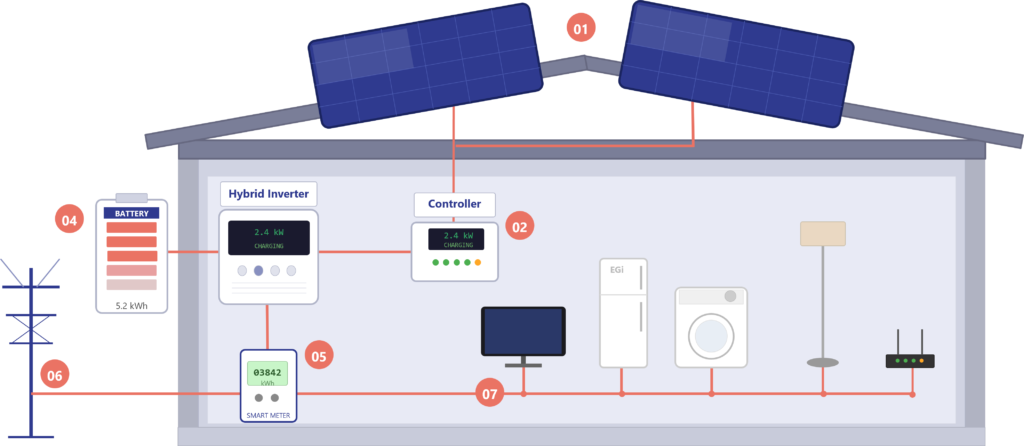
01 — Solar PV Panels
Solar photovoltaic panels mounted on your roof convert sunlight into DC (direct current) electricity, even on overcast days. A typical domestic installation of 8–12 panels produces 3–4 kW, enough to significantly reduce your reliance on grid electricity.
Already have solar panels? Your existing system carries on working exactly as it does now. Adding battery storage doesn’t affect your setup or your Feed-in Tariff payments.
New installation? As an MCS-accredited installer, EGi Energy will design and install a system tailored to your roof, your usage, and your budget — qualifying you for Smart Export Guarantee (SEG) payments from day one.
02 — Controller
The controller is the brain of your energy system. It monitors solar generation, battery charge levels, and household demand in real time — then automatically routes power where it’s most valuable. By prioritising self-consumption first and battery charging second, it ensures surplus energy is only exported to the grid when it benefits you most.
For FIT customers, this means you keep earning your full generation and export payments while using far more of your own solar energy instead of giving it away. For new customers on the SEG, the controller maximises the value of every unit you generate — using it at home when electricity is expensive, and exporting when it’s not needed.
03 — Hybrid Inverter
The hybrid inverter converts your solar panels’ DC electricity into usable AC power for your home, while also managing battery charging and discharging — all in one unit.
If you’re adding a battery to an existing solar system, the hybrid inverter replaces your current solar inverter. Your generation meter stays in place and your FIT payments continue as normal. For new installations, the hybrid inverter is fitted as part of your complete system from the outset.
04 — Battery Storage
The battery stores excess solar energy generated during the day for use in the evening and overnight, when your panels aren’t producing. Instead of exporting surplus energy to the grid for little or no return, you keep it and use it when you need it most.
FIT customers: Your FIT payments stay exactly the same — deemed export is calculated at 50% of generation regardless of whether you have a battery. The battery simply means you buy less electricity from the grid, cutting your bills on top of the FIT income you’re already receiving.
New customers: The battery maximises self-consumption of your free solar energy, reducing what you need to buy from the grid. Any genuine surplus is exported and earns you SEG payments.
A typical 5 kWh battery can power an average home’s evening usage for several hours.
05 — Smart Meter
The smart meter records how much electricity you import from and export to the national grid, providing accurate real-time data to your energy supplier.
For existing FIT customers, your generation meter remains in place and is completely unaffected — the smart meter works alongside it. If you’re on a deemed export tariff, your FIT export payments continue to be calculated at 50% of generation as before.
For new customers, the smart meter is required to access the Smart Export Guarantee, which pays you for every unit of surplus solar energy you export to the grid.
06 — Grid Connection
Your home stays connected to the national grid as a backup. When your solar panels and battery can’t meet demand, the grid supplies the shortfall. The difference with battery storage is you’ll draw from the grid far less — especially during expensive peak evening hours.
When your battery is full and your home doesn’t need the power, surplus energy flows back to the grid. FIT customers continue earning their existing export rate. New customers receive SEG payments for every exported unit.
07 — Home Appliances
Nothing changes for your appliances. Your TV, fridge, washing machine, lighting, and broadband all run exactly as they do now. The only difference is where the electricity comes from — the system automatically prioritises free solar energy first, then battery, and only draws from the grid when needed. You don’t need to change any appliances or how you use them.
FAQs
How much can I save with solar panels?
A typical 4kW solar system in the North West generates around 3,400 kWh per year. If you use 50% of that directly (and export the rest), you could save £400–£500 annually on electricity bill. Add a battery and your self-consumption jumps to 70–80%, increasing savings to £700–1,000 per year. You can save even more money with a smart tariff like Octopus Go and charge your battery overnight at roughly 7–8p/kWh, this is especially relevant in the winter months when your solar panels aren’t generating a lot of energy. Exact savings depend on your roof, usage patterns, and tariff.
Do I need a south-facing roof?
South-facing is ideal, but not essential. East and west-facing roofs work well too, they generate around 85% of what a south-facing roof produces. East-facing panels catch morning sun, west-facing catch afternoon and evening sun, which can actually be better for households who use more electricity later in the day. North-facing roofs aren’t recommended. We’ll assess your roof during the free survey and let you know what’s possible.
Can I add a battery to my existing solar panels?
Yes. We install AC-coupled batteries that work with any existing solar system, regardless of the brand or age of your inverter. The battery connects after your inverter, so there’s no need to change or upgrade your existing equipment. Installation typically takes one day.
Will adding a battery affect my Feed-in Tariff?
No. AC-coupled batteries connect after your generation meter, so your FiT payments continue exactly as before. You’ll still receive your full generation tariff and deemed export payments. The battery simply stores power that would otherwise be exported, you’re keeping more of your own electricity instead of giving it to the grid.
How long does installation take?
Solar panel installation typically takes 1–2 days depending on system size and roof complexity, while battery-only installations usually only takes 1 day, we’ll confirm the timeline during your survey. Most installations cause minimal disruption, we’ll need access to your loft and consumer unit, and your electricity will be off for a short period while we connect the system.
What brands do you install?
The solar panel brands we install include JA Solar, Longi, and Aiko. For batteries, we’re approved installers for GivEnergy, Fox ESS, Solax, Hanchu, Pylontech and Tesla Powerwall. And for Inverters, we work with Solis, GivEnergy, Fox ESS, Hanchu and SolarEdge. We’ll recommend the best combination for your property and budget during the survey.
Do you offer finance?
Yes. We offer finance options to spread the cost of your installation. Subject to status and affordability checks. Ask us for details during your quote, we’ll explain the options available and help you find a plan that works for your budget.
ACCREDITATIONS
Our MCS certification, TrustMark registration and PAS 2030 compliance demonstrate our commitment to quality installation standards. RECC membership, QualityMark accreditation and CHAS certification give you confidence in our consumer protection, insurance-backed guarantees and health and safety practices.
Case Studies

ECO4 Retrofit Project: 45 Bungalows in Fair Havens Court, Widnes
Property Details Location: Fair Havens Court Properties: 45 Bungalows Project…

ECO4 Retrofit Project: 9 Flats in Lilly Road, Liverpool
Property Details Location: Lilly Road, Liverpool Properties: Flats 1 to…

ECO4 Retrofit Project: 4 Flats in Ford Road, Upton
Property Details Location: Ford Road, Upton Properties: 4 x 2…